A Paris elopement is a romantic, intimate wedding celebration in Paris, typically involving a symbolic ceremony distinct from the legally required French civil marriage at a mairie. Meanwhile, most international couples choose to legally marry in their home country first, then hold their symbolic ceremony in Paris for the full emotional experience. The result is a deeply personal celebration with no compromise: you get the Seine at golden hour, the Eiffel Tower as your backdrop, and vows written entirely in your own words. This guide covers everything from legal distinctions to permit rules, planning timelines, and creative ideas for making your day unforgettable.
What is a Paris elopement, and how does it actually work?
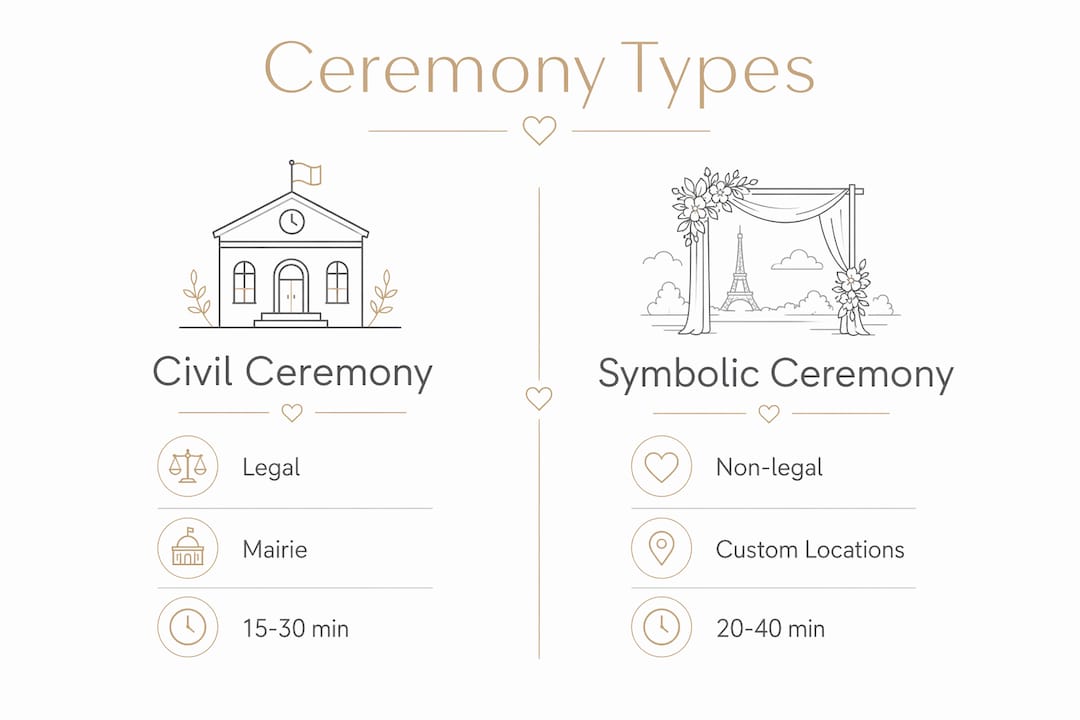
A Paris elopement typically separates two distinct events: the legal civil ceremony and the symbolic personal celebration. Understanding this distinction is the single most important decision you will make during planning, and it shapes everything from your timeline to your budget.
As a result, the French civil ceremony is the only legally binding form of marriage in France. It takes place at the local mairie (city hall), lasts 15 to 30 minutes, and follows a formal legal script that includes readings from the civil code, an exchange of consent, signatures, and the issuance of a livret de famille. There is no room for personalized vows or creative decor. A Paris city hall wedding is official, but it is not cinematic.
A symbolic ceremony carries no legal weight but offers complete creative freedom. You choose the location, the officiant, the vows, the flowers, and the entire atmosphere. Most couples who dream of exchanging vows in front of the Eiffel Tower or in the Jardin du Palais Royal are imagining a symbolic ceremony, not a civil one. Both are valid. Both serve different purposes.
The practical reality for international couples is that civil marriage logistics in France involve residency requirements, document translation, and publication of banns at least 10 days before the ceremony. Residency must be established at least one month at the mairie where the ceremony is held. This complexity leads the majority of international couples to legally marry at home and symbolically celebrate in Paris.
Civil vs. symbolic vs. religious: a quick comparison
| Ceremony type | Legal status | Location | Duration | Personalization |
|---|---|---|---|---|
| Civil (mairie) | Legally binding | City hall only | 15 to 30 minutes | None |
| Symbolic | No legal standing | Anywhere in Paris | 20 to 40 minutes | Complete freedom |
| Religious | Varies by country | Church or venue | 30 to 60 minutes | Moderate |
How to plan a Paris elopement: steps and timelines
Planning a Paris elopement well in advance is not optional. Start planning 6 to 12 months before your intended date to secure preferred venues, photographers, and avoid seasonal booking conflicts. Paris in spring (April to June) and early fall (September to October) books out fast.
Here is a practical sequence to follow:
- Decide your legal approach first. Determine whether you will legally marry in France or in your home country. If you choose France, contact the mairie of your chosen arrondissement at least six months out to understand their specific document requirements.
- Gather your documents early. A French civil marriage requires birth certificates, proof of identity, proof of address, and for non-French speakers, certified translations of all documents. Translation services are mandatory and must be arranged through a certified translator.
- Book your symbolic ceremony venue. Gardens, rooftops, riverbanks, and private courtyards all work beautifully. Some venues require advance booking or a small fee. Confirm availability and any restrictions before committing.
- Hire your Paris elopement photographer early. The best photographers in Paris book 9 to 12 months in advance, especially for spring and fall dates. Your photographer is also your most valuable logistics partner on the day.
- Hire a local officiant. English-speaking officiants who specialize in symbolic ceremonies in Paris are in demand. Confirm they can write a personalized ceremony script in your preferred language.
- Plan your day in two parts. If you are doing both a civil and symbolic ceremony, schedule them on separate days. The civil ceremony is administrative. The symbolic ceremony is your celebration. Mixing them on the same day dilutes both.
Pro Tip: Book your symbolic ceremony for the late afternoon, ideally starting 90 minutes before golden hour. Paris light between 5 and 7 p.m. in summer is extraordinary, and your photos will reflect it.
What permits do you need for iconic Paris elopement locations?
The Eiffel Tower is the most requested backdrop for a Paris elopement, and the rules around it are more nuanced than most couples expect. Discreet personal ceremonies at public viewpoints near the Eiffel Tower generally do not require permits. A couple, an officiant, and a photographer with a handheld camera can hold a quiet symbolic ceremony at Trocadéro or Champ de Mars without any authorization.
The rules change the moment you add scale. Large floral installations, amplified sound, drones, and commercial filming all require permits that can take weeks to obtain and are not guaranteed. The Paris city authorities are protective of public spaces, and enforcement has increased in recent years.
Here is a practical breakdown of what is and is not allowed at public Paris locations:
- Allowed without a permit: Handheld bouquets, a single ring box, one photographer with a handheld camera, quiet spoken vows, a small group of guests
- Requires authorization: Large floral arches, tripods, lighting rigs, drone photography, amplified music, commercial video production
- Prohibited entirely: Blocking public access, large crowds that disrupt other visitors, any setup that requires fixed installation
For locations beyond the Eiffel Tower, the rules vary. The Luxembourg Gardens and Palais Royal are popular for intimate ceremonies and generally permit quiet personal use. Private venues like rooftop bars or boutique hotel terraces require direct negotiation with the property.
Pro Tip: Working with a local Paris planner or photographer who knows the regulations saves you from expensive mistakes. They know which locations are permit-free, which require advance notice, and which are simply not worth the paperwork.
Creative ideas for your Paris elopement ceremony and photoshoot
The symbolic ceremony is where your Paris elopement becomes entirely yours. The city offers settings that no other destination can match, and the best experiences go well beyond the obvious landmarks.
Consider these ideas for your ceremony and photography:
- Seine riverbanks at dawn. The river at 7 a.m. is quiet, golden, and almost entirely tourist-free. A short ceremony on the Pont des Arts or near the Île Saint-Louis at sunrise creates images that feel genuinely private.
- Private Haussmann courtyards. Several boutique hotels and private residences in the 6th and 7th arrondissements offer courtyard access for intimate ceremonies. The architecture is stunning and the setting is completely secluded.
- Rooftop ceremonies with a city view. Paris rooftops offer a 360-degree backdrop that no ground-level location can replicate. Several venues in Montmartre and the Marais specialize in small intimate events.
- Garden ceremonies in lesser-known parks. The Parc de Bagatelle in the Bois de Boulogne is famous for its roses and far less crowded than the Luxembourg Gardens. The Jardin des Plantes offers a botanical backdrop that photographs beautifully.
A well-paced symbolic ceremony runs 20 to 40 minutes and includes a processional, personal vows, a reading, a ring exchange, and a recessional. Ceremonies under 20 minutes feel rushed; anything over 40 minutes can lose momentum, especially outdoors.
After the ceremony, build in time for a champagne toast, a slow walk through a neighborhood you love, and a relaxed dinner at a bistro that means something to you. The couples who remember their Paris elopement most vividly are the ones who treated the whole day as an experience, not just a photo opportunity. A Paris elopement photographer who works in a documentary style will capture those in-between moments: the laugh over a croissant, the quiet hand-hold on a cobblestone street, the look you exchange before the vows begin.
Key takeaways
A Paris elopement works best when couples separate the legal civil ceremony from the symbolic celebration, plan 6 to 12 months in advance, and work with local professionals who know the city’s permit rules and hidden locations.
| Point | Details |
|---|---|
| Legal vs. symbolic distinction | The French civil ceremony is legally binding; the symbolic ceremony is personal and held anywhere. |
| International couple strategy | Most international couples legally marry at home and hold their symbolic ceremony in Paris. |
| Permit rules at iconic locations | Discreet ceremonies with one photographer need no permit; large setups require advance authorization. |
| Planning timeline | Start 6 to 12 months out to secure photographers, venues, and legal documents without stress. |
| Ceremony pacing | A symbolic ceremony of 20 to 40 minutes with personal vows, readings, and a ring exchange hits the right emotional rhythm. |
Why the legal paperwork is the least romantic part, and why it matters most
I have photographed dozens of Paris elopements, and the couples who arrive most prepared are the ones who sorted out the legal side early and then completely let it go. The mistake I see most often is treating the civil ceremony and the symbolic ceremony as the same event. They are not. One is administrative. The other is the story you will tell for the rest of your life.
The other misconception I encounter regularly is that a Paris elopement means standing in front of the Eiffel Tower at noon with a hundred tourists in the background. That version exists, but it is not the only version, and honestly, it is rarely the most beautiful one. The couples whose photos I am most proud of are the ones who trusted me to take them somewhere unexpected: a quiet courtyard in the 7th, a rooftop in Montmartre at dusk, a bench in the Parc de Bagatelle surrounded by roses in June.
Weather is also something couples underestimate. Paris in March can be stunning or gray, and you cannot control it. What you can control is building flexibility into your day. If you have a two-hour window for photos and the light is perfect for only 40 minutes of it, a photographer who knows the city will move you to the right spot at the right moment. That instinct comes from experience, not from a location list.
My honest advice: spend less time worrying about which landmark to stand in front of and more time thinking about what you actually want to feel on that day. Paris will take care of the rest.
— Liya
Plan your Paris elopement with Chouettelove
Chouettelove specializes in photographing intimate weddings and elopements in Paris for international couples who want something real, not staged. Every session is personally guided, from scouting the right location to navigating permit rules and timing the light. Whether you are planning a symbolic ceremony near the Eiffel Tower, a garden elopement in the Bois de Boulogne, or a rooftop celebration in Montmartre, Chouettelove handles the details so you can focus on each other. Explore elopement photography packages built specifically for couples like you, or browse destination wedding services for full planning support from start to finish.
FAQ
Do I need a permit for a Paris elopement ceremony?
Discreet personal ceremonies at public Paris locations generally do not require permits. Large setups including drones, amplified sound, and floral arches require advance authorization that can take several weeks.
Can international couples legally marry in Paris?
Yes, but the process is complex. French civil marriage requires residency of at least one month at the local mairie, certified document translations, and publication of banns at least 10 days before the ceremony. Most international couples legally marry at home and hold a symbolic ceremony in Paris.
How far in advance should I plan my Paris elopement?
Plan 6 to 12 months in advance to secure your photographer, symbolic ceremony venue, and any required documents. Spring and early fall dates in Paris book out quickly.
What is the difference between a civil and a symbolic ceremony in Paris?
A civil ceremony at the mairie is legally binding and lasts 15 to 30 minutes with no personalization. A symbolic ceremony has no legal standing but can be held anywhere in Paris with fully personalized vows, decor, and structure.
Where are the best locations for an intimate wedding in Paris?
Beyond the Eiffel Tower, popular locations include the Luxembourg Gardens, Parc de Bagatelle, private Haussmann courtyards, Seine riverbanks at dawn, and rooftops in Montmartre and the Marais. Each offers a distinct atmosphere and varying permit requirements.
Recommended